
There are many articles about vintage shoe purchasing, finding the right size, caring for your finds, having them repaired, etc, and I have seen some blog posts showing “retro” style modern shoes, but rarely modern made shoes that are actually period correct, or close enough for costume wear.
While the classic '40s shoe silhouette (includes with slight variations the late '30s and early '50s) may be the most common style of shoe worn then, and the one most recognizable today, there was actually a variety of styles worn then including wedges, platforms, and a slightly thinner heel than normal for formal wear, novelty raffia and carved wood – all of which make it easier in finding modern shoes for costumes or just because it's the greatest era of shoe fashion!

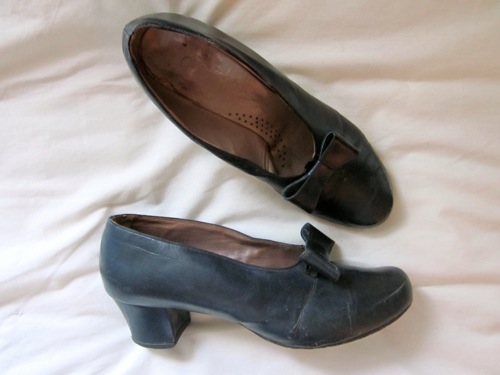
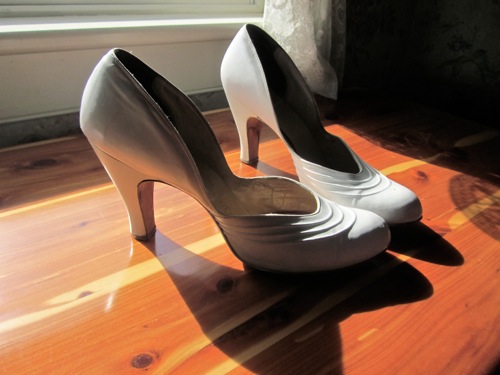
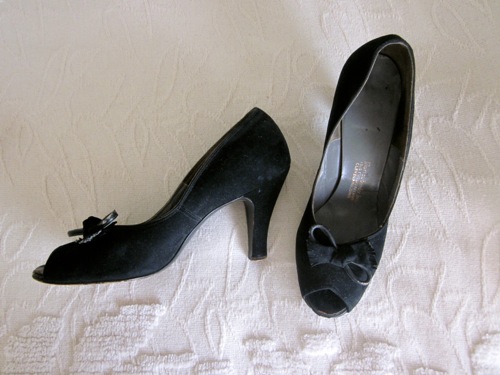
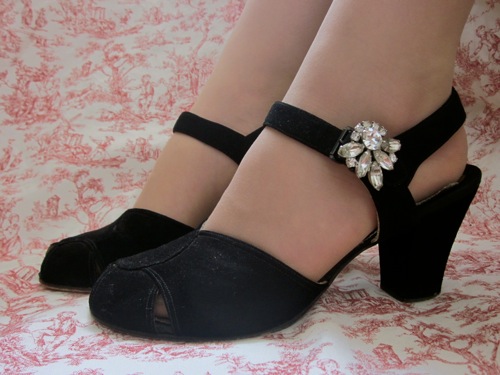
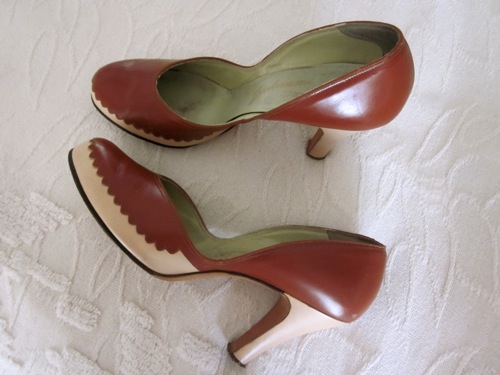
I love actual vintage heels and own quite a few gorgeous pairs like the ones above, but don't like to wear them when doing much walking – both because I don't want to damage them and they are old, and because the soles are usually thin and uncomfortable. So the alternative is to find modern made shoes that are accurate enough to wear with costumes without spoiling the perfect styling of your hair, accessories, and dress.
Thankfully there are some folks out there who actually make reproductions, or shoes that are so close that they work as reproductions. Miss L Fire, out of production Faryl Robin, ModCloth, and B.A.I.T Footwear are all good places (although pricey) to start looking for reproductions. But when shopping avoid shoes that look “retro” because they are wingtip or peeptoe or two-tone, and have a modern heel (stilleto, kitten, etc) or other obviously modern elements – for instance, if the sole is very thick or sticks out far enough to show when you look straight down at the top of the shoe.
Real Life

There are certain characteristics that are pretty much universal when looking for shoes for costume purpose. A round toe…usually something decorative on the toe, whether it's perforations, cut-outs, a flower or bow…if heels, the heel shape. Also the material is important. Modern sparkly shoes, laminated faux wood stacked heels, and plastic-looking super shiny patent leather will still look modern even if the shoe shape is retro.
Avoid high boots, unless they are riding boots worn with a riding outfit. Lace-up oxfords that covered the top of the foot were around, but even in the winter you'll see an expanse of leg between the top of galoshes or short boots and the skirt hem. And I've even seen pictures of girls in heavy winter coats and slingback closed toe shoes, so there's a lot of leeway.
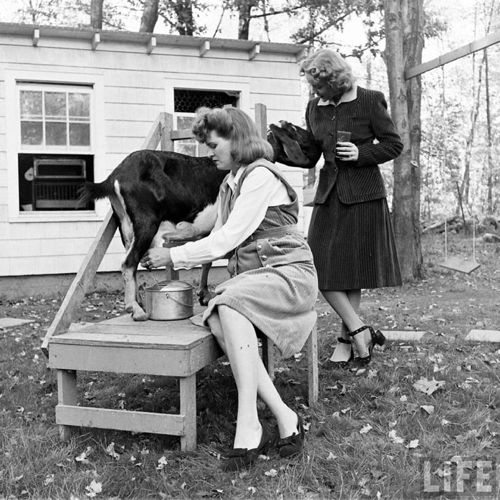
And it is true, hard as it may be for a flip-flop generation to comprehend…they really did wear heels much of the time, even for on-your-feet jobs; while secretaries, telephone operators, and other office type jobs invariably wore quite high heels.
When collecting a costume, keep in mind not just the shoe shape, but also the suitability of them with the outfit you plan to wear. No lace-up shoes with a formal dress…no strappy sandals with a business style suit.
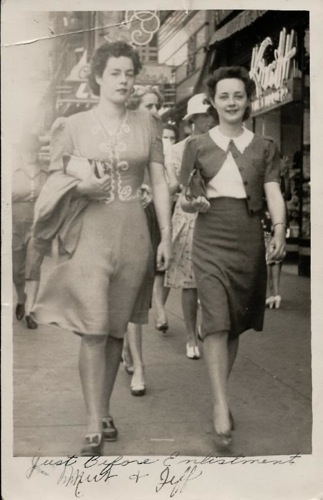
And while I love glamour photos of movie stars and 1940s life portrayed by the movies – hard as it may be to believe – real fashion every day in the 1940s wasn't quite like the movies often portray. For real life fashion, Pinterest is a great place to go and look at casual photos of real people doing different things, and what they wore to do them. I started a Pinterest board here for just such images, and find it fascinating to see which shoes actually were worn for housework or street wear (and incidentally, the everyday hairstyles of the often hatless out-and-about ladies).
Types of Shoes and Modern Finds
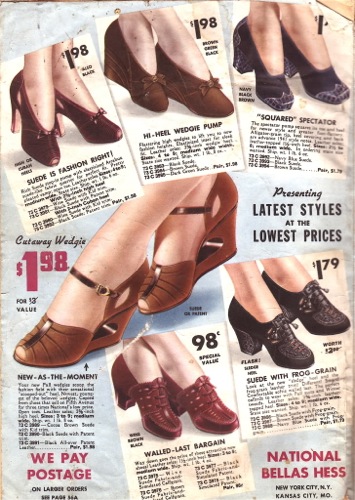
Notice the cutout wedges and the slightly square toes leftover from the '30s in this 1940 ad.
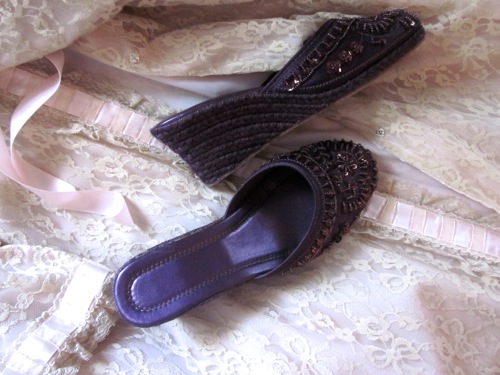
Satin backless shoes, usually with at least a small heel, are perfect for slippers from that era. These would have been worn with pyjamas, negligees, and perhaps house dresses – but never, never out of the house. I found these unbranded modern wedges on Ebay that have a perfect 1940s vibe. Often wedges were covered with the same fabric as the top of the shoe, and while this one has jute as the wedge, since it is dyed the same color it looks quite period correct.
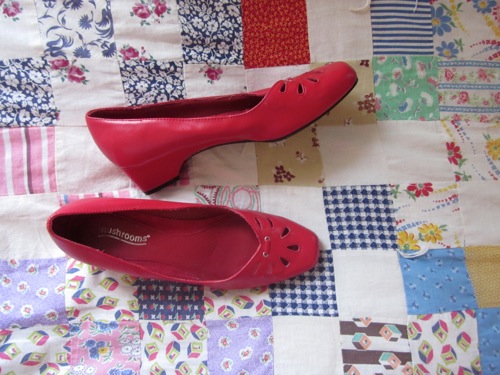
For wearing with housedresses, shoes with lower heels are appropriate. Ballet flats are seemingly nonexistent in the 1940s, so avoid ballet flats. Even flatter shoes like loafers had at least a little heel. These thrift store shoes, actually from the 1980s, are fairly close for house shoes.
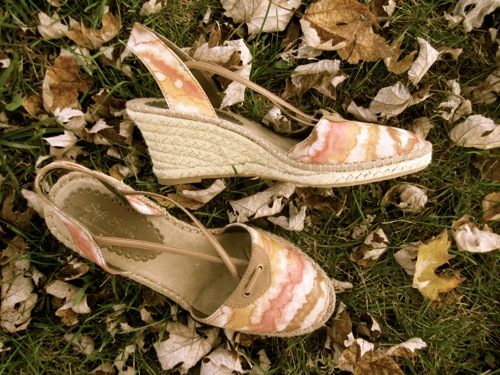
Espadrilles are another option that can cross over from house to street wear and are easier to find from modern shoe makers, although by virtue of their being wedges and usually jute and canvas, they will look less formal and should be worn with more casual street wear outfits, and house dresses. Ankle ties are Period, but check the fabric pattern before you accept them as costume wear.
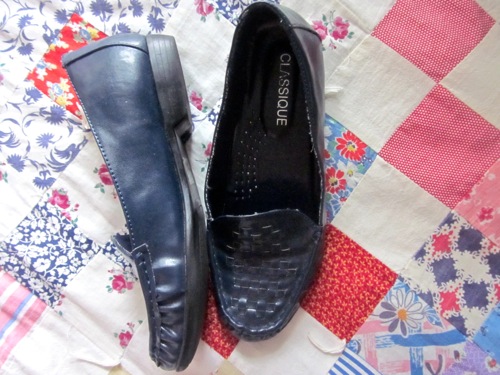
The other type of house and street wear shoe I've seen in photos looks similar to tied tennis shoes – also worn for sports or hiking or other active occupations. Saddle shoes are perfect for this, if you can find them. Flatter wedged loafer or moccasin style shoes were very common for housework, or even on the street for schoolgirls or run-to-the-drugstore errands. These would often be worn with folded down white ankle socks. These are comparatively easy to find – remember to look for a small heel and a rounder toe, like these thrift store woven-top loafers.
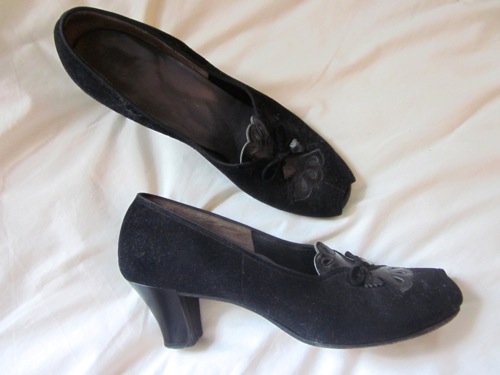
Older women often wore lace-up “granny heels”, oxfords, or lower-heeled sturdy shoes, like these vintage easy-walking-height heels (I didn't have a modern example on hand).
For street wear, heeled pumps and sandals came out of the closet (although again, loafers and lower heels were worn on the street as well). There is a great variety of choices and heel heights here, but keep in mind the suitability of the shoe per your outfit. Sandals shouldn't be worn with business type suits. While even most formal styles usually had at least a small peep toe, slingbacks are as casual as you should go with a suit. A summer two-piece cotton outfit of jacket and skirt doesn't need to be in the suit category. Nice pumps in a conservative color with either a peeptoe or closed toe will be very versatile for outfits and seasons.
Depending on the print of the suit, two-tone pumps are appropriate, and one of my personal favorites. Also, while harder to find to purchase, when found they tend to look more accurate immediately just because they are two-tone. Compare these heels from Aerosoles, of the same basic shoe shape and see how much more Period the top shoe is:
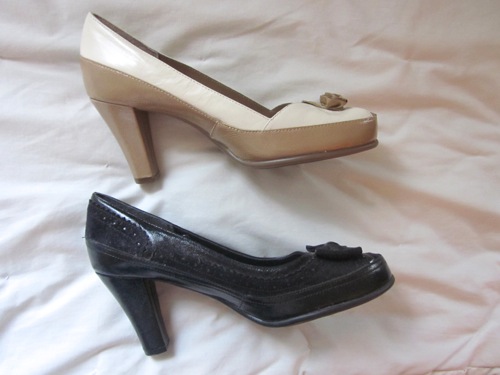
Top: Aerosoles Bengal Rose
Bottom: Aerosoles Bentwood
Part of that reason is the color scheme, but part of it also is another tip of what to look for when shoe shopping – the way the top of the shoe is seamed to the side, with that cute little dip at the top. That is very common – almost universal – in vintage shoes and gives it an instant 1940s-1950s vibe.
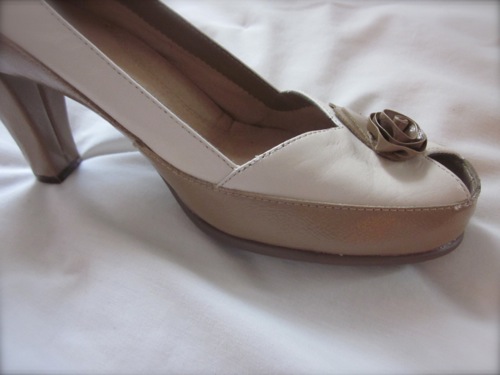
White shoes were everywhere in the summer. While I am still looking for that perfect pair of white and brown, or white and navy spectator pumps, I was lucky enough to find these for summer wear – comfortable and sturdy enough to wear all day.
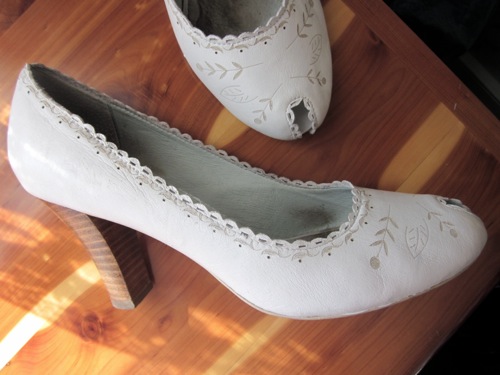
While not completely accurate, I feel they are close enough to wear as costume since the heel is very similar to an actual vintage heel, and the embroidery, leather trim, and tiny trimmed peep-toe are all very Period.
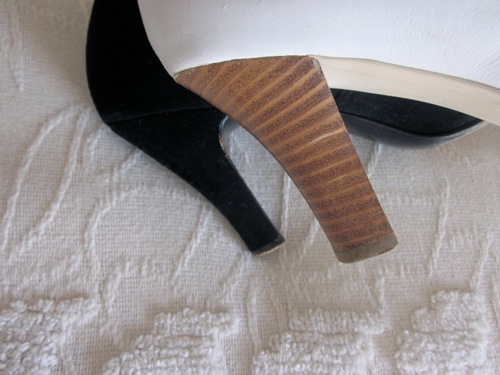
The vintage heel is narrower, but basically the same shape.
Summer shoes also included a lot of sandals. They could have ankle straps or be slingbacks, or the kind with just the toe and heel, with the sides open. I've never seen T-straps in the 1940s, though they were popular in the 1920s and '30s. One thing you want to watch when buying sandals for costume wear is a wide vamp and conservative peep-toe. Except for a few strappy types of sandals, most sandals covered the toes fairly completely. Here are some of my favorites that are 1940s costume worthy, all of them from Ebay, costing me between $15-$40.
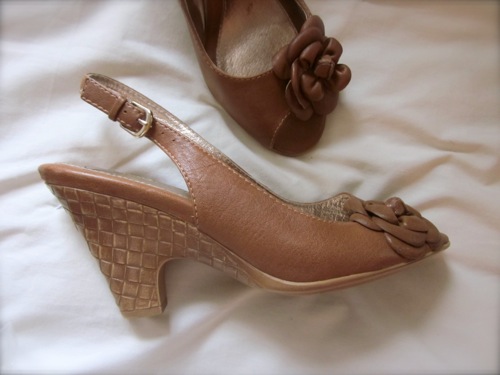
Sofft Versailles sandals. The woven semi-wedge heel style is unusual but still period correct. To make them even more accurate, the flower should be in the center.
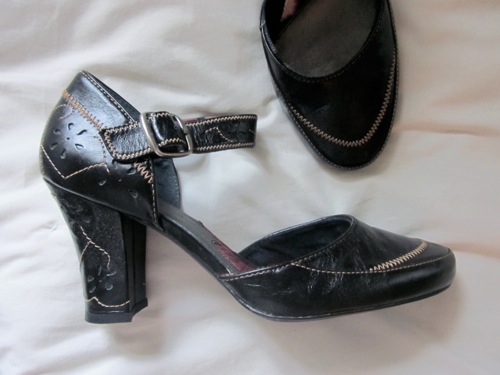
Unusual stitching and cutouts on the heel make these very classy, but while not the most common, decorated heels were certainly around in the 1940s.
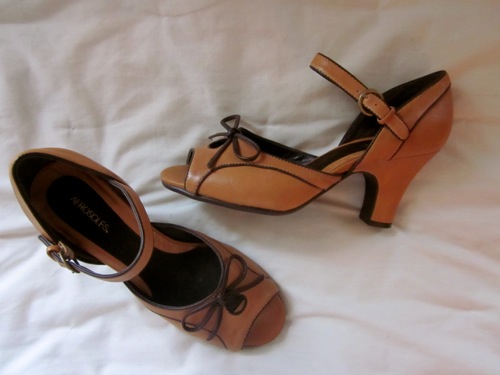
Aerosoles Gingerbread sandals. The only thing not period correct about these beauties is the tractioned rubber sole – and perhaps the elastic behind the buckle – both negligable points for me.
For nurses' and service uniforms, you may want to invest in actual vintage shoes since they were regulated styles. But if not, look for plainer leather shoes in dark colors with closed toes and a chunky heel between 1 and 2 inches. These vintage shoes may well have been part of a nurse's garb in the 1940s.
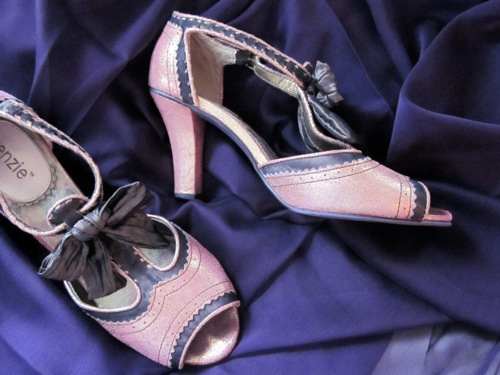
For very formal occasions, like proms or weddings, while leather and suede were always a good option, satin and other fabrics were in vogue, usually with a higher, sometimes thinner, heel and often some special decoration. These sandals by Kenzie have a good overall shape for formal shoes of that era, although I would have to research to see if the pink metallic finish is accurate.
But simple and classy, even for dressy occasions, is always in good taste.

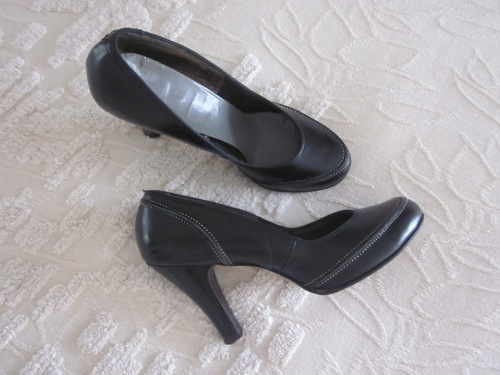
Aerosoles again…I don't know the model name. Notice the leather detail – very Period.
Shopping
The best way to search for modern shoes that are close enough for costume is to familiarize yourself completely through photos and movies from the era with the shoe shape or shapes of the era you want, so that when you see photos of shoes for sale you can instantly pick out ones with the correct lines.
Here's one shopping tip – make sure you see photos of the shoes from all angles, especially the side. If the seller hasn't provided those, ask for them. It's very easy to misjudge the shape of a heel if the photos only show it from one angle.
But take courage, for they are out there! As you can tell, Aerosoles are a favorite of mine for costume possibilities if chosen carefully along with modern comfort and sizing, and they are easy to find and relatively inexpensive. I always have a to-buy list of Aerosoles models!
And of course, if you can find true vintage pumps in your size (which will be different than your modern size, most likely), go for it! Sometimes they do turn out to be comfortable and sturdy enough to be walked in all day – and of course they are always inspiring and gorgeous!


 Verity Vintage Studio
Leave a reply to Kristen Stoltzfus Cancel reply