
A while ago, I posted a short article on sizing vintage gloves. It occurred to me that it might be helpful to write about gloves in general, the different styles, and how to choose the correct gloves, so a two part series is in the works. Part One is a little overview about gloves in general, hints for wearing them, and discussing styles of gloves, regardless of age. Part Two, next week, will be about dating gloves and caring for and/or repairing them.
Glove etiquette used to be very strict. They were a very important part of a ladies' attire (gentlemen's to, but we're concerning ourselves here with ladies' gloves.) Ladies rarely went bare-handed off their own property, even as recently as the 1960s. But since gloves are, sadly, no longer a normal part of going-out attire, when we do wear them we have a lot more leeway in how we wear them, being no longer bound to the danger of committing a social gaffe by wearing “colored” gloves instead of white ones, for instance.
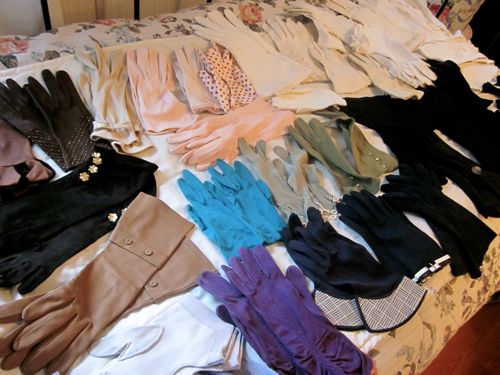
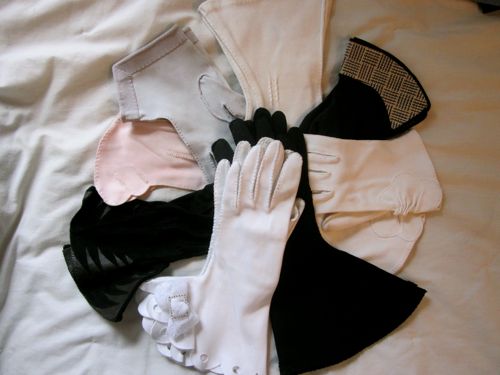
Some of my extensive personal collection.
It is impossible to have too many gloves, or so it seems (can you tell, from the above photo? 🙂 Ideally, a lady needs in every shade of every color a short glove with a fitted wrist, a short glove with a flared wrist, a long glove with a fitted arm, and a long gauntlet-style. Not to mention sometimes beading looks better, or too fussy and you want a plainer pair…or the only pair that are the exact color to match your shoes are leather, and you need them in cotton…You can see why it was normal to own dozens of pairs, if affordable.

Beautiful detailing on a few of my gloves.
They were often works of art and worth collecting just on that note. So many endless varieties on cuffs and hems, ruching and trim, embroidery and lace, cut-out work and inserts, looped trim and beading. Plain pairs could and still can be spruced up by the buyer with embroidery, lace, and buttons. Sometimes they were made to coordinate with the fabric on a handbag, or have matching bows to a certain dress.
Tips for Wearing Gloves
Never wear gloves when you need to eat with your fingers. It may be permissible to wear them while eating with a knife and fork, especially in public like a restaurant (although usually the gloves are removed with the coat, but not the hat, in restaurants) but never while eating popcorn (a mistake admitted by the actress who played Ruth in It's a Wonderful Life) or anything else with the fingers. That may mean, when holding a plate of finger foods, to remove the glove from the hand you eat with, and holding it with your plate in your other hand. Or remove both and place them in your handbag.
Usually the shorter the sleeve, the longer the glove. This is not always the case, since in '40s movies you will see very short cap sleeves with only wrist length gloves, but if you are going to wear elbow-length gloves, make sure the sleeve doesn't come down over them. This does not apply to gauntlet gloves, which are flared at the top and often worn over sleeves, whether blouse, jacket, or even coat.
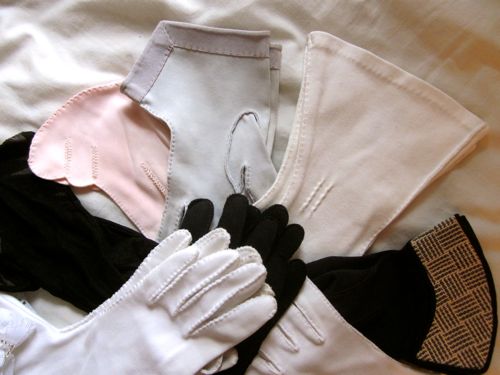
A closeup of some of my gauntlets.
Black and white gloves are always the colors for formal wear; usually I say to choose the color that best goes with your formal dress. Black with maroon, usually; white with dark blue. However, colors like dark red, dove gray, silver or gold, can also be worn formally. White and pastel gloves should be almost exclusively kept for summer, although darker gloves can be worn in warm weather as well, if they match your dress. Keep in mind suitability of fabric when you choose gloves for an event. Dark gloves with straw cuffs are probably not suitable to wear to a dance, while they are fine for church or street wear.

When wearing gloves, they should coordinate with something else you are wearing. In the 1920s, shoes were to match a lady's hose, interestingly enough, and gloves could be odd colors. A little later, it was in good taste that the shoes and gloves of a ladies' outfit should match. While these stricter rules need not apply to today, to create a tasteful appearance, do keep a sharp eye on the colors and styles of gloves you wear, depending on the outfit. If you are wearing black shoes, don't wear brown gloves. If you have a lace blouse on, it may clash to wear long lace gloves of a different type of lace. If you have an elaborate dress, wear more conservative gloves – if you wear dashing gauntlets with a frilly dress, you may look overdressed, or the gloves and dress may take away from each other instead of complimenting. The reverse is also true – a plainer dress sets off a pair of elaborate gloves, with beading or lace inserts. (For a more tailored appearance – think 1950s secretary – both gloves and dress should be conservative, and save the gauntlets for a Sunday stroll or a visit to the races.) If you are wearing a white hat and shoes, but your skirt has dark purple flowers in it, dark purple gloves should look fine – as long as they are the same shade of purple! It's all about what is complimentary.
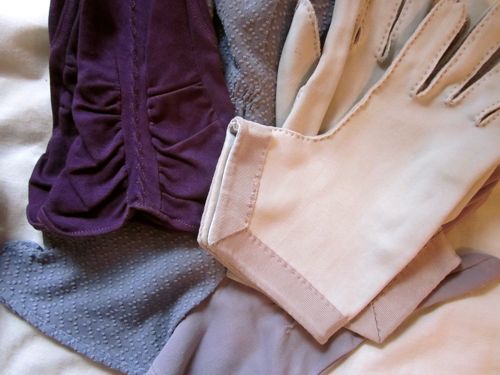
Different shades like purple and lavender give lots of options for the perfect complimentary color.
One particular fad of mine is not to combine gold and silver. If I am wearing blue, with a silver sweater and jewelry, I won't wear gloves or shoes with gold buckles on them. Not everyone has to go that far! I just mentioned it as a point to the small details that, together, give the impression of a tastefully dressed woman – or, if in costume, a historically accurate one.
Now, for some details about gloves…
Types of Gloves
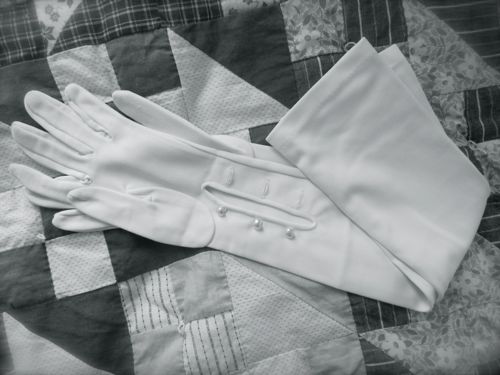
–Opera gloves (mid upper arm or higher) are, of course, only to be worn for formal occasions and with no longer than very short sleeves. Shorter gloves can also be worn for formal occasions, but are not properly styled "opera gloves", and elbow length at least is proper. Until the advent of nylon, they were very difficult to get on and off, which is why most pairs have buttons at the wrist. These were to be unbuttoned and the hand of the glove tucked back out of the way while the lady ate, then resumed for dancing – usually with the assistence of her dinner partner.

But if you have to entirely remove opera gloves for any reason, it is bad taste to do so in public.
Other lengths of gloves are wrist length – which can be very short indeed, barely covering the hand; mid-arm length, and elbow length. Ones that come past the elbow are considered opera length, although as I said above, opera gloves can vary in length as long as they come as far as the upper arm.
Some of my gauntlets and gauntlet-style gloves.
-Gauntlets are striking gloves with flared wrists – sometimes long, sometimes short, usually made from cotton to hold its shape. Often ornate, or unusually cut. The very exaggerated gauntlets are for wearing with flair, while the more conservative styles are appropriate for shopping or church. They are one of my favorite styles, and look elegant worn on a bare arm or over a sleeve.
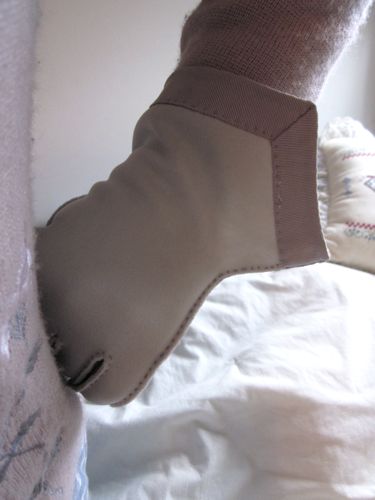
A gauntlet over a sleeve.
-Lace gloves are traditionally the teaparty, summer gloves. Black lace gloves can also be worn with formal evening wear. While cotton and nylon can also be worn in the summer, lace or openwork gloves are usually not worn in cold weather, except for indoor functions. Lace gloves come in many styles, from short to long, crocheted or knitted, mesh, or stretchy. Sheer nylon gloves, also, while not being lace, fit in this category and are for use in warm weather or indoor functions only.

Take note, as in the photo above, that stretchy lace gloves can really fool you on the size! They look like child's gloves, then when you put your hand in, you're surprised to discover they actually fit an adult's!
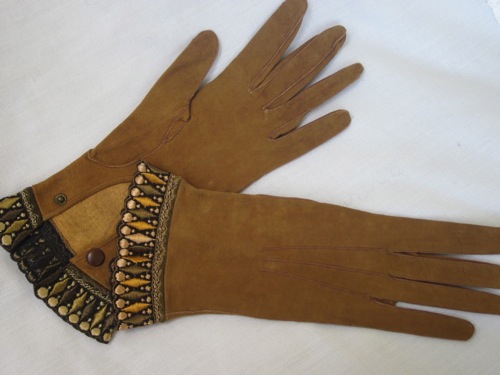
-Leather gloves can be worn in 3 seasons. They are far too hot to wear in summer. While not normally church gloves, thicker leather gloves were and are worn for shopping, and are removed with the coat or jacket, instead of being left on. If you have longer dress gloves (usually they come no farther than to the elbow) of fine thin leather or suede, those can be worn with an outfit, but keep in mind that they are usually harder to remove if you need to remove them quickly, and are warmer. Dress gloves like this usually coordinate best with a tailored, jacket-style ensemble, rather than a frilly or formal dress. They will hold wrinkles more than cotton and nylon, so don't ball them up; because of the way they retain wrinkles they will look old faster than other types of gloves as well.
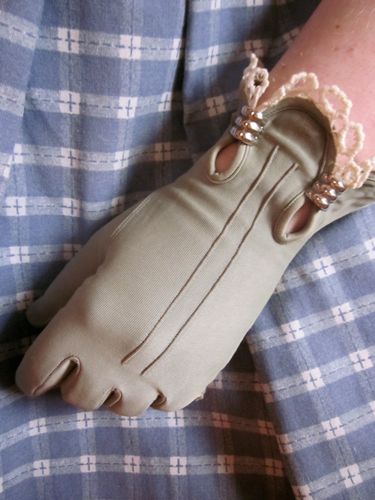
One of my favorite pairs of nylon/rayon gloves, (c) 1930s.
-Nylon or rayon gloves are more forgiving than cotton ones, and often have a better fit because they can be snug without being unwieldy. Because they are slipperier, some ladies find them less pleasant to wear, especially in the summer. There are sheer nylon gloves, mentioned above, and other nylon or nylon blends, very common in the 1960s, although nylon material was also used for gloves earlier on. Before nylon, there was rayon, which is more delicate but also stretchy. Nylon gloves can be wrist length all the way to opera length. They are generally easier to clean.
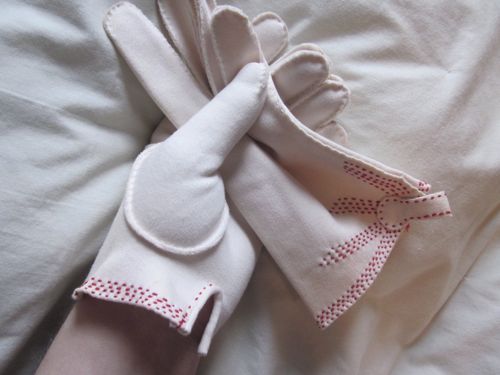
Shorty summer cotton gloves, (c) 1950.
-Cotton gloves are constructed of something often called “double-woven cotton” or "suede" or "kidskin" and are a dense, smooth fabric, comfortable to touch. Because they are usually fairly thick, the seams can sometimes make the fingers uncomfortable or, if they are on the outside, make the hands look large. Cotton is much less stretchy and flexible than the nylon, lace, or even leather gloves; you can often cheat a size smaller with nylon gloves, and leather will stretch out with use (although only a small amount), but if you wear a size 7, for instance, it is risky to purchase a pair of cotton gloves in size 6 ½ unless you try them on first. They are appropriate year round, although often lighter colors for warmer weather and darker colors for winter are most suitable.
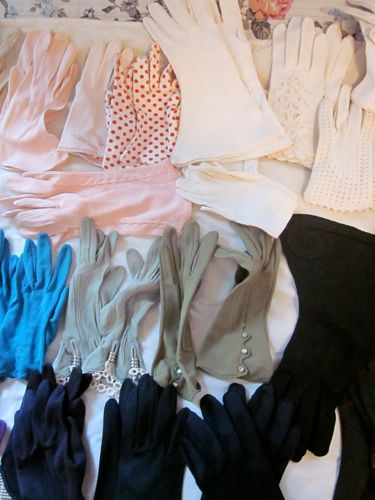
Thanks for taking a peek at my glove collection! For more details on the fascinating subject of gloves, watch for Part Two of this series next week.


 Verity Vintage Studio
Leave a comment