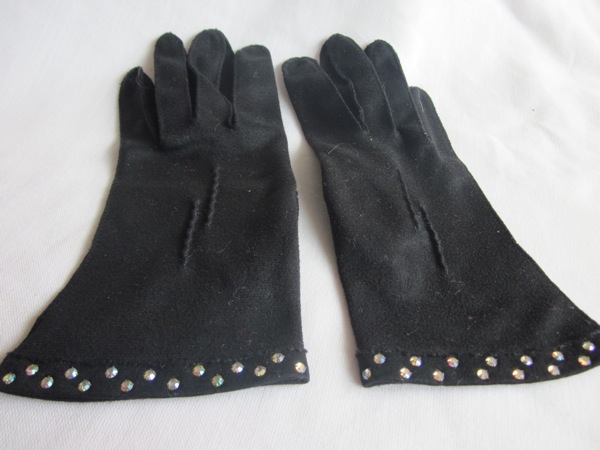
When I started buying gloves on the internet because I couldn't stand not bidding on the beautiful gauntlets I kept seeing, I ran into a problem. Of course that was that I didn't know what size I was, and many vintage gloves didn't have a tag, and the seller often had no clue how to even estimate the size.
Finding out my own size was easy. I went up to my glove box – at that time a much smaller box! – and tried on gloves that fit me until I found one with a size tag in it. I had thought I was a 7 1/2, but found out that I was actually a 7, since I like tighter fitting gloves.
Finding Your Size
Glove measurements are determined by the circumference around the palm of the hand where the knuckles are. So dividing that in half, a size 7 glove should be about 3 1/2 in. across the palm – or 7 in. around.
So measure your own hand, or a pair of vintage gloves that fits you, to determine your size, and when you see some gloves with no size you like on Ebay or some other site, contact the seller and ask them to give you a measurement across the palm of the glove. Photos can be decieving, so don't assume that the gloves are your size without asking. They can be much smaller in real life – as I learned to my own disappointment!
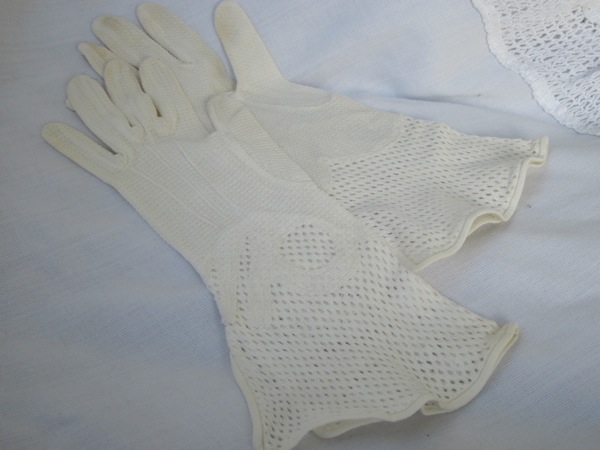
The difficulty comes when you see a lovely pair a size smaller and want to buy it without being able to try it on. I've found that I can also wear a size 6 1/2 as long as it is cotton, or some fabric with a bit of stretch; but leather is too tight for me to comfortably wear in that size. Kid gloves in particular have not an atom of stretch in them. Fabric makes a big difference. I've seen some nylon or knit-fabric gloves that were so stretchy they fit "all sizes" as the tag said, and really did.
Keep in mind that the smaller the palm measurement, the shorter the fingers as well. My sister-in-law has narrow hands, but long fingers, so she can't wear size 6 1/2. If you have long fingers, it's best not to risk paying a lot for a pair of gloves smaller than your common size, unless they are nylon or something similar.
Another factor for fitting gloves is the seams. Personally, I prefer my gloves to have their seams inside because I think outside seams make my hands look big. But the inside seams definitely make a tighter fit for my fingers. To apply – if you see a pair a size smaller than you normally wear and it has seams outside, there will be a greater chance of it fitting you. And the outside seam pairs are easier to mend if needed.
Also, the older the gloves the smaller they are. Apparently everone had tiny hands and feet back then, and they got smaller and smaller from the 30s to the 20s to the Turn of the Century! If gloves are very old, they are almost always too small for the average woman now. But then, older gloves often are not wearable since they are too fragile to clean and if the fabric is intact, the stitches often are rotten and will start breaking if any stress is put on them by someone inserting their hand or bending their fingers.
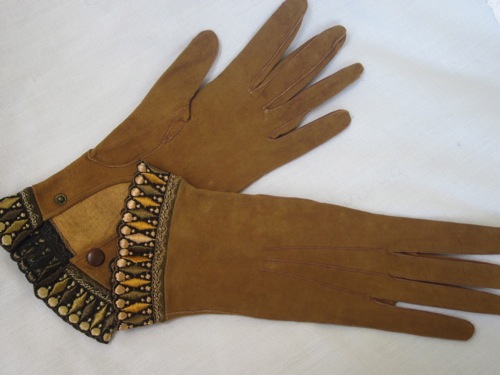
But there are so many, many gorgeous pairs of gloves from the 1940s and '50s that are well worth collecting and wearing as often as you like to church or shopping! I have a particular weakness for gauntlets or gloves with fancy stitching or embellishments. I like to have multiple pairs of gloves in every shade of color, long and short, for every occasion. (Although glove ettiquette is a whole different subject!) It's possible to look through a whole stack of white ones and not find just the right pair or just the right color for your outfit, which is why they are so easy to buy – and often, thanks to Ebay, cheap to buy.
As Hannah said in Little Women, "You can tell a lady by her gloves!" Back in the day, a well-dressed woman always had matching gloves and handbag, or glove and shoe color. It gave an outfit a put-together look still useful today, besides protecting the hands. (Now I just need a good burgundy pair, and some gray ones!)

 Verity Vintage Studio
Leave a comment